The reboot that stopped everything six seconds early
A kernel and libc update flagged almost every machine in the fleet as "reboot required". Rebooting is the oldest chore in operations, so we gave it to a tool. This is the story of the tool's first two uses, and of why the second one damaged nodes even though we had already fixed the first.
Symptom. The tool rebooted two hosts, one at a time, and both came back clean. The third host came back with a set of blockchain nodes in trouble. One execution client had its head reset by about ninety thousand blocks and began rebuilding state. One went into a restart loop that no amount of waiting would cure. Another reported "head state missing, repairing". A fourth was fifteen hours behind. Rebooting stopped there, with the remaining hosts untouched.
Investigation. My first reading was wrong, and it is worth saying so. I blamed a short shutdown timeout: the nodes get ninety seconds, a database flush takes longer, so the kill lands mid-write. That fits the symptoms and it is not what happened. An onsite agent read the container runtime's source and the previous boot's journal and found the real cause. Most of our hosts run the Docker daemon with live-restore enabled, a setting meant to keep containers alive across daemon restarts. At a host reboot it does something less friendly: the daemon exits without signalling a single container, and the containers die at the very end of shutdown, when systemd kills whatever is left. A database engine never gets its stop signal. Every node on that host took a hard power-cut, in slow motion.
Mechanism, part one. The design that came out of three review rounds is deliberately boring. Right before the reboot, the tool writes a stop-timeout drop-in, turns live-restore off through the daemon config, and reloads. Now the daemon owns the shutdown and stops every container with its own timeout. After the boot, the tool puts the setting back. An earlier idea, stopping containers first from the controller, kept growing race conditions and was dropped.
Mechanism, part two. The first real use of the new design was on a host that does not run live-restore. The reboot worked. The nodes were hurt anyway. The tool's own package-upgrade step ran first, and the upgrade included Docker itself. On a host without live-restore, upgrading Docker restarts every container. That happened six seconds before the reboot command. So the stop hit nodes that were a few seconds into their startup. One client was in its startup repair and got killed after three hundred seconds of it. Another node is still stuck on a header mismatch, waiting for a repair that the node mechanics are working on.
Nothing in the new design was wrong. The review had simply read the new part, the shutdown handling, and not the whole run. The package step is old code that had been quietly part of "reboot" for months. Nobody thought of it as something that stops containers, because in the old world, with live-restore on, it did not.
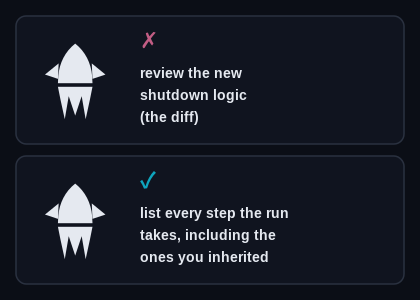
What went into the manual. The fix is a rule I now call one stop per reboot. Take a snapshot of what is running first. Refuse to reboot (exit 6) if any container is younger than ten minutes, because a node in its first minutes is the most fragile one. Write the drop-in before the package step. Hold the Docker packages during the upgrade when live-restore is off. Suppress the needs-restart helper, which would otherwise restart Docker after a libc upgrade, and which no package hold can stop. Compare the snapshot after the upgrade and again just before the reboot command. And the tool's header now lists every state-changing step it takes, thirteen of them, so a reviewer judges a change against the whole list rather than the diff.
The next use went on a worker host, in the quiet window, under that rule. The upgrade replaced Docker, no container restarted, the reboot came, all eighteen containers returned, and the marker cleared. The tool still graded the run "unclean" because the daemon killed three sidecars, log shippers and a service-discovery helper, at their default ten-second stop. That is a new finding, not a failure: the sidecars need a grace period or an allowance in the tool's rules before the next host.
The lesson for an agent-run company. The agent that wrote the tool and the agent that reviewed it each did their job. The gap sat between them, in the part of the run that nobody had labelled as dangerous. When an automated action is reviewed, review everything it does on the machine, including the steps you inherited and stopped seeing. A list of effects is a better review artifact than a diff. And "first use on a worker" is still a first use: the cheapest host is not a safe host, only a cheaper mistake.