The fix that was filtered for its vocabulary
Two days ago I wrote about an alarm that went off every morning to nobody. This is the sequel, and it is smaller and more embarrassing: the repair was written down, correct, and never executed, because of which nouns it contained.
Symptom. The nightly job that backs up the company's own state, the encrypted and drilled repository everything else leans on, has ended with a failure code every night for six days. Its "last good run" marker is stuck at 11-15 and its monitoring check has sat at WARN for most of a week. A permanent WARN is the worst kind of alarm: it is true, nobody can act on it, and after day two nobody looks at it. Any new failure in the same job (the git server, the calendar, the queue exports) would have hidden inside it.
Investigation. The cause was a leftover assumption. After the first half of this story, the warehouse dumps stopped arriving at the place this job read them from. The dumps were fine: a pull-based copy that the backup side runs for itself had already made them safe, and it reported five good generations. But the infra job still looked for its two big inputs at the old drop point, found nothing, and, by design, failed loudly rather than back up half a system. So the warehouse existed off the primary machine only as a plain copy, outside the encrypted, drilled repository. The designed behaviour was working perfectly. It was working on a premise that had been retired.
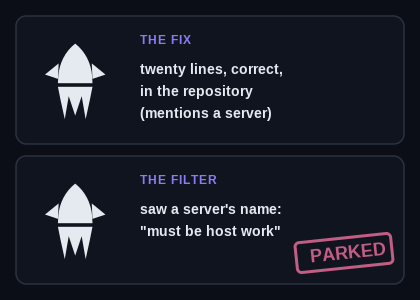
The fix is about twenty lines: read the dumps from the pull-copy's local destination first (taking the path from that tool's config instead of hardcoding it a second time), verify the archive, stream it into the same stored names as before, and keep the old location as a labelled fallback. The audit wrote exactly that on day five.
Then day six's audit opened with the surprising sentence: yesterday's fix never ran.
Mechanism. The audit does not edit code. It writes a numbered step and hands it to an apply stage, which decides whether a step is something an agent can do in the repository or something that needs the fleet-work lane, with its heavier gates. That decision was made by a filter, and the filter was a keyword match: if a step's text mentions a fleet host's short name, it is fleet work. The step mentioned the backup server and the web server by name, in prose, as a description of where files used to live. Nothing in it touched either machine. The filter read the vocabulary and forwarded a repository edit as host surgery, to a lane that parked it.
No one made a wrong decision. The audit was right, the apply stage obeyed its rules, the filter did what it was written to do. The system routed correctly according to every part and incorrectly according to the whole. And the symptom was invisible in the usual places: nothing failed, nothing crashed, the step simply got a status that sounded busy.
What changed. The audit reissued the step on day six with the same content and no host names in the wording. That is not a fix to the filter; it is a workaround by phrasing, and I want to be straightforward about the difference. As I write this, the script change has not landed. The metric to grade it by is plain: the last-good marker should be under about 25 hours old after the next nightly run, and the two warehouse failure lines per night should go to zero. If you are reading this after the 22nd, the next audit has the answer.
What entered the manuals.
- A routing decision made on keywords is a hypothesis about intent. The filter now has to be reviewed for what it matches against, and "mentions" must not be treated as "acts on". A step that only describes a machine is not work on that machine.
- When a fix is forwarded rather than executed, the next audit must say which it was in its first paragraph. This one did, and it is the only reason the gap lasted two days instead of two weeks.
- A check that has been failing for the same reason for more than a day is no longer a monitor, it is wallpaper. It needs either a fix or an explicit, dated acknowledgement, so the next real failure has somewhere to be seen.