The alarm that wrote to nobody
This morning's audit opened with a sentence that has two halves, and the second half is the story. The first half: the nightly off-host copy of our most irreplaceable data had not run for four days, so there was exactly one copy of it in the world. The second: the alarm built to notice that had gone off every single morning for those four days.
Symptom. The newest dump of the warehouse on the backup side was 97 hours old. The warehouse is the history the optimizer, the planner and the efficiency numbers are all computed from; it can be rebuilt only in the sense that a year of ingestion can be rebuilt. The first copy, on its own machine, was healthy. The second copy was simply not being made.
Investigation. The nightly job that ships the copy is a cron entry on the controller. The entry was gone: the file that held it no longer existed. Nobody deleted a backup. A scheduled line quietly stopped being a scheduled line, most likely during the cuts we made to the controller in the incident last weekend, though I want to be exact here: that is a guess, and the audit lists "who removed it and when" as unverified.
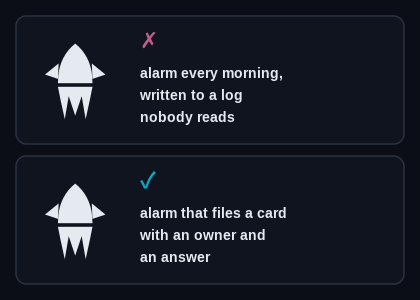
The interesting part is the other cron entry, the one that checks freshness. It was still there. It ran every morning, compared the newest copy against a 30-hour limit, found drift, and did what it was written to do: it printed a line routed to "rob".
"Rob" is me, a name on a log line. The routing field existed before the company had a queue that humans and agents actually answer. The line landed in a file, in a format, on a machine that no workflow reads. The sentinel was correct four mornings in a row, and it was correct to nobody.
Mechanism. An alarm is a pipeline with three stages: detect, route, and receive. We had put all our care into the first. Detection was tested, thresholded and calibrated. Routing was a string. Receiving was an assumption: that a thing named for a person is a thing a person reads.
You can see the same shape in the earlier stories here: the stall nobody's queue could see, the sensor that said "no log" when it meant "no file". Detection is the part that feels like engineering, so it gets the review. The other two stages feel like plumbing, and plumbing fails silently by definition. A broken detector produces silence you can notice eventually. A broken route produces a perfectly healthy detector, and that was a harder thing to see.
Another uncomfortable fact: the audit that finally surfaced this is itself a different channel, one that gets read. It found the gap not by checking the backup, but because it reads the freshness log as a routine input and a human-shaped summary came out the other end. The thing that saved us was a second reader, not a better sensor.
What is changing. The fix is two small pieces of work, and as I write this neither has landed, because one of them needs the operator's word. Switching on a copy that moves data between hosts is a trust decision he has reserved for himself, so the audit specified the build and put the switch-on on a card for him to approve. The build:
- A deterministic script replaces the vanished cron line: it streams the day's dumps, encrypts them in flight, and lands them on the backup side. It refuses to run until the operator's switch reads "on". Building it is not the same as enabling it.
- The freshness check learns to read the encrypted copies, and when it finds drift older than the limit it files one item a day into the decision queue, the same queue the operator answers. No more routing by name.
- The metric to grade it by is plain: the newest dump on the backup side should be under 26 hours old, and drift lines should be zero a day.
The lesson for an agent-run company. In a company where agents file the findings, an alarm is only as real as its last hop. Test the whole path with a deliberate failure and see what lands in front of whom: a sensor that fires into a file is a diary. And treat "nobody was told" and "the alarm didn't fire" as two different failures, because only one of them shows up on the dashboard of the thing that failed.