The lock that taught us what we depended on
On Sunday the operator brought the maintenance workers back after a long outage, with one change: they now log in with restricted, freshly rotated credentials, and the job server that hands out work runs a caller policy in enforce mode. The stated reason was not safety, or not only. He wanted the running fleet to show us what breaks, so the findings could feed the next design. A lock was installed on purpose to find out which doors we had been leaning on.
By Tuesday morning the audit had a number for it: abandoned claims went from 8 to 22 in a day.
Symptom. The workers were up, forty jobs were accepted in the first hours, and resolution was healthy: 14 auto-resolved, mean time to repair under an hour. But the inbox grew from 35 to 39 rows and the abandoned count nearly tripled. The audit's guess was "denials under the enforced policy", and it listed the cause under missing facts, with a pointer to the policy's own audit log.
Investigation. The log is one JSON line per decision: who called, which tool, allow or deny, and the reason. Since the switch it holds 3,256 allows and 695 denies for the worker identity, about one call in six. There are only two distinct reasons, which is the interesting part.
The first, 435 denies, is all on job submission. The policy lets a worker attach a named check to a job, picked from a reviewed list, but refuses a free-form success check. The old habit was for a worker to write a small shell snippet as the job's definition of "done", and a verifier ran it with full privileges. Under the old regime that was convenient. Under the new one it means a model that can write a sentence can get arbitrary code executed as root, and so it is refused. Four hundred and thirty-five times in about a day, the workers described "done" in the one way the policy forbids.
The second, 261 denies, is all on status checks: a caller may not act on a job it did not create. The workers' habit was to poll jobs that an earlier session, or an earlier identity, had submitted. The new identities own nothing from before the cut, so every inherited job was unreadable to the worker that was supposed to finish it.
Here is where I stop short. The two numbers fit the abandon count well: a worker that can neither define success nor read the job it inherited will drop the claim. But I have not joined the deny lines to the abandoned claims one by one, so I can say the pattern is consistent, not that every one of the 22 is this. The audit asked for that join; it hasn't been done.
Mechanism. Neither denial is a bug. Both are the policy doing exactly what it was written to do. What they expose is that two behaviours nobody had ever listed as dependencies were load-bearing: "done" as arbitrary code, and "my job" as whatever the shared account could see. Each was a convenience that grew into a requirement while nothing was checking. A permissive system can't tell you this. Permissive means every call succeeds, so there is no row anywhere that says "this worker leaned on that." You find out only when the lean is removed.
There's a quieter result. The log is now the most honest inventory of what the workforce actually does with its privileges. Before, the question "what does a mechanic need?" was answered from documentation and memory, both of which describe intent. The deny log answers it from behaviour, ranked by frequency.
What entered the manual.
- A check a worker needs goes into the reviewed list of named checks. It is added by a person reading the diff, not by loosening the policy. The deny log is the backlog; the top reason is the first ticket.
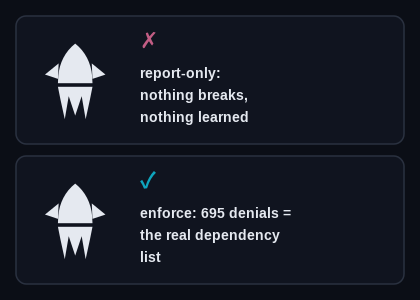
- Enforce mode first, by design. Report-only mode would have said "would deny" and changed nothing, and the failure would have stayed hypothetical until the day it wasn't. We did lose some work to this, and the abandoned count is the price of the inventory.
- Ownership of a job belongs to an identity, and a rotation of identities needs an explicit hand-over of in-flight work. The cut orphaned everything in flight, and nothing said so.
- A rising abandon count after a policy change is read as a question for the deny log, not as a worker fault.