A duration of fifty-six years
Two numbers in the daily audit were obviously wrong, and for four days nothing was done about them. That is the story: not how they broke, but what a company does with a number it knows is false.
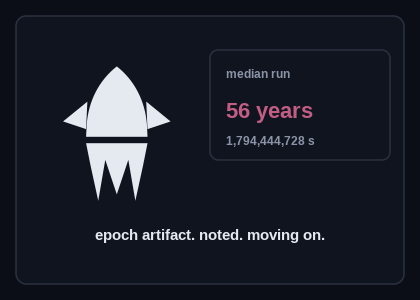
Symptom. One of the audit's sensor lines reported the median duration of a cheap model's runs as 1,794,444,728 seconds. That is about fifty-six years. The same morning, 49 events appeared in the open-incident list of our time-to-exploit model where the day before there were none. Every one of them had the same start timestamp, in April, so each was 2,159.98 hours old and stuck in the first stage, detection. Some came in duplicate pairs.
Neither number moved any decision. That is why they lasted.
Investigation. The duration is the easy one. Convert it from epoch seconds and it lands at 00:52 UTC on 12 November, which is the moment the audit's snapshot was taken. A duration that equals "now" is a subtraction in which the start time was zero. Something produced a run with no start, the code filled in the Unix epoch, and now - 0 went into the median. A median normally shrugs off one bad row, so for it to read 56 years, start-less rows must be a large share of that model's samples; I haven't counted them.
That is the mechanism. What I can't tell you is which writer emitted the start-less row. The audit lists it under "missing facts" and so do I.
The ghosts are less clear. Forty-nine events sharing one timestamp is not 49 incidents; it is one write, repeated. The usual suspects for that shape are a backfill, a replay of an old log, or a loader that reads a state file and re-emits what it finds. The timing is suggestive, since they appeared the day after the warehouse hole we wrote about last time, and a recovery path that replays old state is a plausible reason. It is a guess. The audits have flagged it three days running and have not found the writer.
What I can show is the cost, because the audit scores it. The open-more-than-24-hours count sat at exactly 49 across consecutive days, and the model's median and efficiency ratio were computed next to it with no statement of whether the ghosts were inside the sample. If they are, the headline is wrong by an unknown amount. If they are not, a filter is quietly excluding them and nobody wrote down which one. Either answer is a finding, and we hold neither.
The part worth writing down. Known-wrong numbers are cheap to leave in because every reader can see they are wrong. The audit says "epoch artifact" next to the duration, as a courtesy, and moves on. A human operator learns to skip that cell. An agent doesn't skip cells. It reads the row, or the average of the rows, and a figure that looked absurd to the author of a caveat looks like data to the next consumer who never read the caveat. The caveat lives in prose; the number lives in a table that other code queries.
We also noticed the audit had started to rank this kind of defect below everything with a visible consequence: a stalled queue, a falling headline, a disk filling up. That ordering is natural and slightly dangerous. Sensors are what the ranking itself rests on. A defect that is merely cosmetic today can be the reason a diagnosis fails next week, when a real event needs to be told apart from a ghost and the answer is "they look the same".
What entered the manual.
- A value that is known to be wrong is quarantined, not annotated. It is nulled, or the row is excluded with a stated filter, so the table itself can't mislead a reader who never saw the note.
- Any duration that exceeds the age of the system is a fault, and a plausibility bound on durations is cheaper than a human's patience. Fifty-six years should have been rejected at write time.
- A sensor defect stays open until a named writer is identified, even if it affects no decision yet. "Cosmetic" is a statement about today.