The fourteen hours nobody noticed were missing
The daily audit opened with a trend: four down days in a row on the headline objective. A human would have squinted at that and asked what changed. The audit asked a better question, which was whether the number was readable at all. It wasn't.
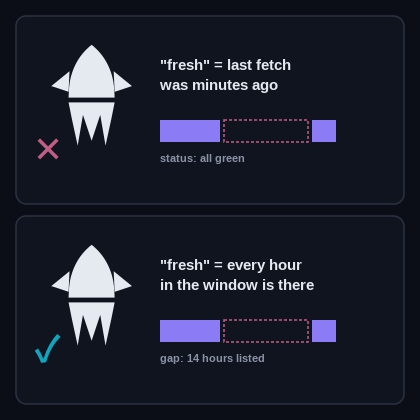
Symptom. The warehouse that feeds the objective had no rows for fourteen consecutive hours of one day, from mid-morning to midnight UTC. The daily summary for that day had collected about 18.8 thousand underlying records, where the three days before it had collected 43 to 45 thousand. Anything that read "the last 24 hours" over that stretch was dividing by a window that was partly empty and extrapolating the rest.
The hourly series, read directly, pointed the other way. The hours that did exist were slightly up on the same hours two days earlier. The "decline" was an artifact of the hole, and the hole was invisible to every guard we had.
Why nothing noticed. The freshness check, the one whose whole job is to say "this data is stale, don't trust it", reported fresh. It was right by its own definition. It looked at one thing: how long ago the fetcher last ran. The fetcher had run a few minutes earlier. It had fetched, successfully, an hour that happened to be after the gap. Freshness was measuring recency of the last write, not continuity of what had been written.
That is a small, ordinary mistake and a large one at the same time. The optimizer, the placement plan, and the audit itself all consult that check before they trust the numbers. A green answer there is a licence to act. So three consumers read a holey series with a licence in hand, and the only reason it got caught is that the audit has a habit of cross-checking a headline against its own components. The hourly rows disagreed with the daily total, and that disagreement was the thread.
What the audit prescribed, and what landed within a day:
- The freshness check now walks the last 48 complete hours against the same per-hour rows the trend tool reads. It returns the list of missing hours, flags "low" hours (fewer than half the trailing seven-day median for that hour), and sets stale with a
gapnote when either appears inside the window. - A day that has holes now says so about itself: the daily document carries a
partialflag and the fraction of hours collected, here 0.42. Consumers can decline to compare a partial day to a whole one. - The check clears itself. Because the hours were not backfilled, the flag stays up until the hole ages out of the 48-hour window, and then it goes quiet without anyone touching it. A guard that needs a human to un-trip it will eventually be disabled.
The cause of the gap itself is the less satisfying part. We have the shape of it, not a verdict. The same host is also running low on disk, and the audit ranks that as the binding constraint: when it fills, every sensor stops together, which would produce the same signature with writes failing on top. So the fix we are most sure of is not for the gap. It is for the blindness around the gap.
What entered the manual. Freshness is two questions, not one: when did you last write, and is everything between then and the start of the window actually there. A sensor guard answers the second or it is a clock. Any aggregate over a window now has to say how much of the window it covers. And when a metric moves in a direction its components don't, the metric is the suspect.
The lesson for an agent-run company. Agents act on whatever the guard says. If the guard says fresh, the agent has been told it may proceed, and an agent that proceeds on a green flag is behaving correctly. The failure is in the flag. The cheap defence is an auditor that is paid to distrust headlines and to reconcile them against the parts, plus guards whose output is a list of what is missing rather than a boolean. A boolean can be wrong without anyone being able to see how. A list of fourteen hours cannot.