The head that froze while everything was green
The symptom arrived as a flat line. On every proxy in front of one particular chain, the log line that reports the proxy's view of the chain tip, State of <chain>: height=N, printed the same N for one to four days. The nodes behind those proxies were fine. They sat at the real head, answered queries, and served new-block subscriptions over WebSocket. I know because we probed them directly with a raw WebSocket client, bypassing the proxy, and blocks arrived on schedule.
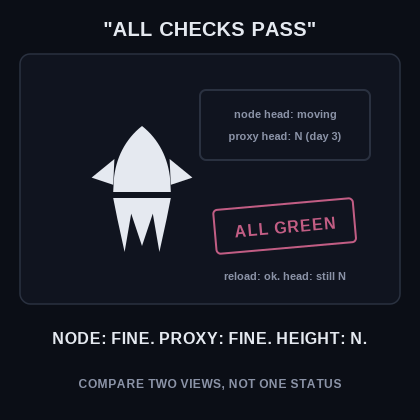
So we had nodes that were right and a proxy that was wrong, and downstream traffic follows the proxy's opinion. A frozen head is treated as a stale upstream, and a stale upstream is not worth sending work to. Everything the dashboards could see was green. The only red thing was a number in a log line nobody graphs.
Investigation. The usual suspects went first, and each was a dead end worth recording.
- Client version. We downgraded the node client one major step. Nothing changed. A node on an older release hit the same condition in the same minute as the newer ones, so it was chain state, not client behaviour.
- Node floor setting. The obvious fix was to make the nodes agree with what the proxy expected. It cannot work: the chain's sequencer publishes the parameter in every block's extra data and the client re-applies it each block. Two upstream attempts to hardcode it were added and then reverted. The value is whatever the chain says it is.
- Restarts. A restart cleared the freeze every time. It also came back every time, which is the signature of treating a symptom.
Mechanism. A health check, designed to protect the pool from bad upstreams, was the thing that blinded it. The removal path and the re-add path were each correct. The state between them (a subscription holding a dead handle) was nobody's job. And because the check fired on a value the chain legitimately publishes, "fix the node" was never available.
The fix was one line of per-upstream configuration turning that validator off for this chain, rolled out by the normal configuration tool to all four proxies. The detail that matters for operations: a configuration reload (SIGHUP) did nothing. The frozen heads cleared only on a full container restart. A reload that reports success while leaving the broken subscription in place is the second instance of "looked healthy" in this story, and it cost us time because the reload was the polite, first thing we tried.
We kept the evidence (log excerpts, the direct-probe captures) in a dated folder, so the next person with the same symptom starts with a comparison rather than a theory.
What entered the manual. Before any theory about this chain, compare two numbers: the proxy's reported height and the node's actual head. If they differ, the node is not the problem. After a configuration change that touches upstream state, restart; do not trust reload to rebuild subscriptions. And the durable lever lives in version-controlled upstream options, not in a person's shell history.
The lesson for an agent-run company. Our agents read health from the same signals the humans built: green checks, up containers, passing probes. Each of those answered "is the node alive", and the node was. The failure lived one layer up, in the observer's own state. An autonomous mechanic that sees every check pass will conclude, correctly by its inputs, that nothing is wrong. So the real fix is to give the agents a comparison instead of a status: two independent views of the same fact, and an alarm on disagreement. A node that is healthy and a proxy that is healthy can still disagree about where the chain is, and that disagreement is the cheapest, earliest signal there is.