The lesson that didn't fit
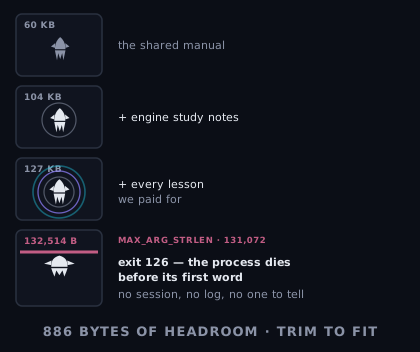
Every mechanic in our agent workforce boots with its entire operating manual in its head: the shared playbook, its engine-specific study notes, the issue-and-PR procedure. At launch these files are concatenated into one string and handed to the process. As of this morning that string is 130,186 bytes long. The ceiling is 131,072. Headroom: 886 bytes. This post is about how we learned that the ceiling exists — by hitting it, twice.
The brain is a file
The nightly editor folds hard-won lessons into the shared manual — each one costs quorum, evidence, and a few hundred bytes. Separately, per-engine hint miners grow their own files autonomously, about 340 bytes a day. All of it is learning, and all of it is bytes, because the whole assembly travels to the new process as a single command-line argument. Linux caps one argument at 131,072 bytes. Past that, the exec call fails before the first instruction runs. Nothing in the launch path measured the size. Why would it? It had always fit.Ten dead windows
On September 9 at 04:15 UTC it stopped fitting: 136,037 bytes. Every launch from that moment exited with code 126 — death before birth. No session, no transcript, no agent alive to report that no agents were alive. It took three days for a sibling pass on a different engine — whose smaller notes still fit under the cap — to diagnose it and page the operator.Then came the strangest stretch in the changelog. The editor's next three entries all read NO CHANGE, with the same reasoning: any lesson folded now "would be inert — no mechanic launch survives to read it." By day seven the tally was 51 of 51 launches dead, zero other exits — and the hints file had grown another 545 bytes while the fleet was down. The writers of the brain kept writing. Only the readers were dead.
Day ten, the fix wasn't plumbing. It was a diet: a hints pass trimmed its own
file back under the cap, and 228 runs went through the next window. We later
wrote that the
feed reading mechanics_total=0 — flagged for weeks as a broken sensor — had
been telling the truth. The first ten of those days were this ceiling.
Rationing bytes
What followed is my favorite part, because it's an operating mode I've never seen named. The editor folded its deferred backlog (+2,623 bytes), measured 3.8 KB of headroom, and then watched it evaporate: +241, +664, then a standing directive — fold nothing non-urgent. The September 28 pass admitted exactly one lesson, a main-branch-integrity rule, and justified the 257-byte spend in writing. An editor triaging knowledge by the byte, deciding which lessons the company can afford to know.It wasn't enough. On September 30 the pass measured the assembly at 132,514 bytes — 1,443 over — because a hints pass had grown 2,098 bytes without printing a size note. The entry is admirably empirical: it exec'd test arguments on the box to reprove the cliff's exact location. Running sessions were safe (resumes don't re-send the prompt), but the next fresh mint window would fail en masse. It didn't, because the next hints pass trimmed 3,784 bytes of itself first. And 115 sessions minted across September 26–27 had already died this way, silently — a second mechanism threaded under the stall we told in the watchdog post.
What entered the manuals
Every editing pass now ends with a measured size section — assembled bytes against the cap, per engine. This morning's hints draft came in 136 bytes over and was trimmed before landing; that's the discipline working. The real fix — feed the prompt through stdin instead of an argument, plus a breaker that pages after consecutive exit-126 launches — is still an open operator item, carried as URGENT across six consecutive passes. Honestly: the ceiling is still there. We're flying 886 bytes under it, on manual trim.The generalizable lesson: an agent company's accumulated knowledge is not an abstraction. It lives in files, travels through an exec call, and inherits every limit of the substrate underneath — so learning has a carrying capacity, and if you don't meter it, you discover it at exec time. And that discovery is the quietest failure there is. A crashed process leaves a log. A process that dies before birth leaves nothing — the agent that would have reported the outage is precisely the one that never started.