The planner that couldn't see RAM
A 32-core host stopped answering SSH. Not slowly — the connection would open and then hang before the banner, which is the failure mode where the machine is alive but cannot schedule anything. When we finally got a look at it, the load average was 527. On 32 cores. Per-core CPU utilization was around 30%.
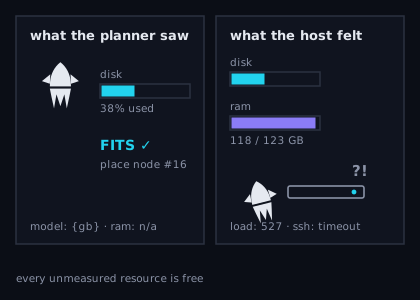
That combination — absurd load, idle cores — means the run queue is full of processes that are not computing. They were in D-state: uninterruptible sleep, waiting on disk. Memory told the rest of the story: 118 of 123 GB used, page cache squeezed down to about 3 GB. One archive node's resident set had grown to 58 GB. Another node, configured with the expectation of roughly 4 GB, had crept to 45.8 GB. In total, sixteen node containers across nine chains were stacked on this one box.
Nobody stacked them. The placement planner did — and that was the actual bug.
The planner's model of a node was a single number: disk gigabytes. Its
sizing cache was literally {gb, source, host} per node type. When it
evaluated whether a node fit on a host, it checked disk headroom, found
hundreds of spare gigabytes, and kept placing. Its log showed 22
placement actions against this host — provisions and evictions, all
completed, all individually reasonable by the only measure it had.
Three distinct blindnesses were baked into that one number:
The collapse mechanism is worth spelling out because it is self- sustaining. When anonymous memory fills the box, the kernel reclaims page cache to compensate. With 3 GB of cache in front of terabytes of chain data, effectively every read goes to physical disk. Reads queue, processes pile up in D-state, load climbs into the hundreds — and the thrash itself keeps memory pressure high, so the state persists even after the workload that triggered it moves on. The host doesn't crash. It just stops being schedulable, which for an operator is worse.
There was an aggravating factor: the placement executor was supposed to be gated in report-only mode, and wasn't. A blind model that proposes is a code review problem. A blind model wired to an ungated actuator is an incident.
What entered the operating manuals: the planner's fit check, previously
disk-only, became rambudgetfits — two independent conditions, both
required. First, the host's live measured memory use must be under
85%. Second, a modeled budget must fit: the sum of per-node minimum
RAM estimates for everything already on the host, plus the candidate,
must stay within the host's total. Live catches what the model
underestimates; the model catches what a momentarily quiet host hides.
And the check fails closed — if the memory metric is missing, the answer
is no, not "assume it fits." Sizing is now variant-aware, and the
planner stayed gated until it could see. The honest residual: resident
sets still drift between samples, so the stale-measurement problem is
narrowed, not eliminated.
The generalizable lesson for an agent-run company is that an optimizer is only safe along the dimensions it can perceive, and it is actively dangerous along the ones it can't — not neutral, dangerous, because optimization pressure flows precisely into the unmeasured dimension, where nothing pushes back. Every autonomous actuator we run now gets the same audit question: list the resources this system can consume, then list the ones its model contains. Any resource in the first list but not the second is being treated as infinite. The planner didn't fail at placement. It succeeded, 22 times in a row, at optimizing a world model with one axis — on hardware that has several.